
You discover that someone has copied your work. Maybe it's your latest YouTube video, a blog post you spent days writing, a product photo from your online store, or an original song that's suddenly appearing on another website.
You know your content has been stolen, but now what?
Many creators immediately search for "how to file a DMCA" or "copyright infringement," assuming the two terms mean the same thing.
They don't. In fact, confusing the Digital Millennium Copyright Act (DMCA) with copyright is one of the most common mistakes creators and businesses make when trying to protect their intellectual property online.
Understanding the difference isn't just legal knowledge; it can save valuable time, improve your enforcement strategy, and help you remove infringing content more effectively.
In this guide, we'll explain what copyright is, what the DMCA does, and when each applies.
Table of Contents
- What Is Copyright?
- What Is the DMCA?
- DMCA vs. Copyright: What's the Difference?
- When Should You Use a DMCA Takedown?
- Common Misunderstandings About DMCA and Copyright
- Best Practices for Protecting Your Content Online
- How Pellonia Helps Protect Your Intellectual Property
- Frequently Asked Questions (FAQs)
- Final Thoughts
What Is Copyright?
Copyright is a legal protection automatically granted to creators of original works.
The moment you create an original piece of content in a tangible form, whether it's a video, photograph, article, illustration, software program, podcast, or song, you generally own the copyright to that work.
Copyright gives creators exclusive rights, including the ability to:
- Reproduce their work
- Distribute copies
- Display or perform it publicly
- Create derivative works
- License or sell those rights to others
In simple terms, copyright establishes ownership. It tells the world that the work belongs to you.
What Is the DMCA?
The Digital Millennium Copyright Act (DMCA) is a United States law enacted in 1998 to address copyright issues in the digital environment.
Rather than creating copyright, the DMCA provides a legal framework for enforcing existing copyright online.
One of its best-known features is the DMCA takedown process, which allows copyright owners to request that online service providers remove infringing content from their platforms.
Today, many websites, hosting providers, social media platforms, and search engines use DMCA-based reporting systems to respond to copyright complaints.
DMCA vs. Copyright: What's the Difference?
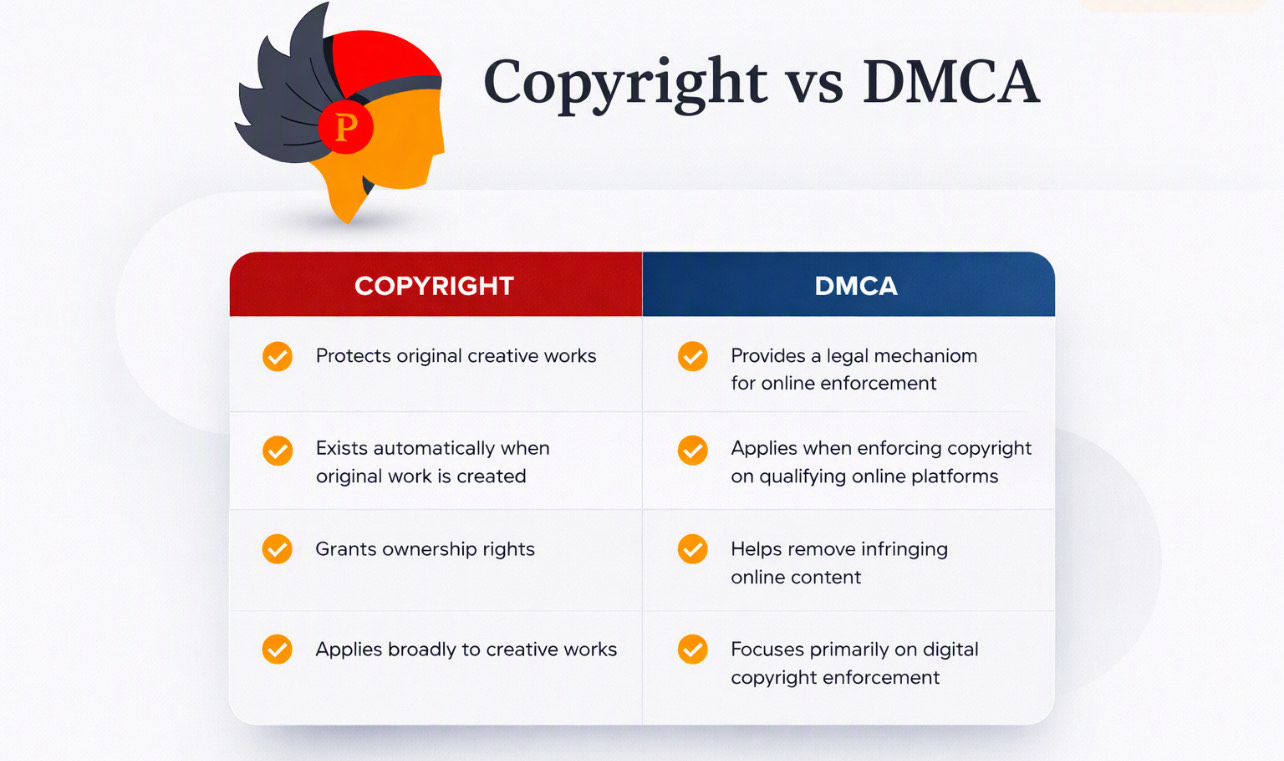
Although the terms are often used interchangeably, they serve different purposes.
|
Think of it this way:
Copyright is your legal ownership.
The DMCA is one of the tools you can use to enforce that ownership online.
When Should You Use a DMCA Takedown?
A DMCA takedown request may be appropriate when someone has uploaded or distributed your copyrighted work online without permission.
Examples include:
- Someone republishes your blog article.
- Your YouTube videos are re-uploaded.
- A website copies your product photography.
- Your digital course is shared on file-sharing sites.
- Someone uploads your music without authorization.
- An online marketplace uses your copyrighted images.
The goal isn't to punish users. It's to stop unauthorized distribution and restore control over your content.
Common Misunderstandings About DMCA and Copyright
Many creators unintentionally make enforcement more difficult because they misunderstand how copyright works.
- "I need to register my copyright before I'm protected."
- Not necessarily. In many countries, copyright exists automatically once an original work is created. Registration may provide additional legal benefits, but protection often begins immediately.
- "Every country follows the DMCA."
- No. The DMCA is a U.S. law. However, many international platforms voluntarily use DMCA-style reporting systems because they operate globally.
- "The DMCA protects trademarks."
- No. The DMCA addresses copyright, not trademark infringement. Trademark disputes usually follow different reporting procedures.
- "Sending a DMCA notice guarantees removal."
- Not always. Platforms typically review requests before taking action. Incomplete or inaccurate submissions may be rejected, and uploaders may have opportunities to dispute certain claims.
Best Practices for Protecting Your Content Online
Waiting until your content is stolen isn't the best strategy. Proactive protection is far more effective. Consider these best practices:
- Monitor Your Content Regularly
Search for unauthorized copies across websites, social media platforms, marketplaces, and search engines. - Keep Original Files
Maintain timestamps, source files, and publication records that demonstrate ownership. - Document Infringements
Capture screenshots, URLs, and dates before reporting violations. - Act Quickly
Unauthorized content often spreads rapidly. Early enforcement typically leads to better outcomes. - Develop a Long-Term Protection Strategy
Businesses publishing content regularly should think beyond individual takedowns and implement continuous monitoring and enforcement processes.
How Pellonia Helps Protect Your Intellectual Property
Understanding copyright law is one thing.
Enforcing it consistently is another.
Pellonia helps businesses, creators, and brands identify unauthorized uses of their intellectual property across websites, social media platforms, search engines, marketplaces, and messaging services.
Our team assists with monitoring, evidence collection, preparing copyright complaints, coordinating takedown requests, and helping clients reduce repeat infringements.
Rather than spending valuable time searching for stolen content, you can focus on creating while we help protect what you've built.
Frequently Asked Questions (FAQs)
Q: Is the DMCA the same as copyright?
No. Copyright establishes legal ownership of original creative works, while the DMCA provides a legal process for enforcing copyright online.
Q: Do I automatically own the copyright to my work?
In many jurisdictions, yes. Copyright generally exists as soon as an original work is created and fixed in a tangible form.
Q: Can I send a DMCA takedown if someone copied my YouTube video?
If you own the copyright to the video and it has been uploaded without your permission, you may be able to submit a copyright complaint through YouTube's reporting process.
Q: Does the DMCA apply outside the United States?
The DMCA is U.S. legislation, but many international online platforms use DMCA-style procedures to handle copyright complaints.
Q: Can the DMCA protect my logo?
Not usually. Logos are typically protected under trademark law rather than copyright law, although some artistic logos may also qualify for copyright protection.
Q: How can Pellonia help?
Pellonia helps creators and businesses monitor their online presence, identify copyright infringements, prepare compliant takedown requests, and implement long-term intellectual property protection strategies.
Final Thoughts
Copyright and the DMCA are closely connected, but they are not interchangeable. Copyright gives creators legal ownership of their work. The DMCA provides one of the most widely used tools for enforcing those rights in today's digital world.
Knowing the difference allows creators and businesses to respond more effectively when infringement occurs and build stronger long-term protection strategies.
If your original content is part of your business, protecting it shouldn't be an afterthought. It should be part of your growth strategy.
Need help protecting your content online? Pellonia helps businesses, creators, and rights holders monitor, detect, and remove infringing content across major online platforms.
Contact our team to learn how we can help safeguard your intellectual property.


