
Copyright is an important part of protecting a business's creative and commercial assets. Website content, product photographs, marketing materials, software, videos, presentations, illustrations, training materials, and original written content can all have commercial value. When these works are copied, distributed, modified, or published without authorization, the business may lose control over how its intellectual property is used.
In Canada, copyright protection generally arises automatically when an original work is created and fixed in a material form. Businesses do not need to register every work before receiving protection. However, automatic protection does not eliminate the need to establish who owns the work, maintain reliable records, and understand how copyright can be enforced.
Canadian copyright law also includes protections that businesses sometimes overlook, particularly moral rights and the rules governing fair dealing. These principles affect how companies commission creative work, use third-party materials, negotiate contracts, and respond to unauthorized online use.
This guide explains the main principles of Canadian copyright law in 2026 and outlines practical steps businesses can take to protect their creative assets.
Table of Contents
- What Is Copyright Under Canadian Law?
- What Types of Work Does Copyright Protect?
- Does Copyright Protection Arise Automatically in Canada?
- Should Businesses Register Their Copyright?
- Who Owns Copyright in Work Created for a Business?
- Understanding Moral Rights in Canada
- What Is Fair Dealing and When Does It Apply?
- How Long Does Copyright Protection Last?
- How Does Copyright Work Across Canada and the United States?
- What Counts as Copyright Infringement?
- How Can Canadian Businesses Enforce Their Copyright?
- Common Copyright Mistakes Businesses Should Avoid
- How Pellonia Helps Protect Copyright Online
- Frequently Asked Questions
- Final Thoughts
1. What Is Copyright Under Canadian Law?
Copyright is a legal right that protects original creative works. Under Canada's Copyright Act, copyright owners generally have the exclusive right to produce or reproduce a work, publish it, perform it in public, communicate it to the public by telecommunication, and authorize others to exercise certain rights.
These rights allow creators and copyright owners to control how their work is used and commercially exploited. A business that owns copyright in its marketing materials, software, photographs, or other original content can generally prevent unauthorized reproduction or use of a substantial part of those works, subject to the exceptions and limitations established by law.
Copyright is different from a trademark or patent. It protects the expression of an idea rather than the idea itself. For example, copyright may protect the original text and photographs on a company's website, but it does not give the company exclusive ownership of the general business concept, subject matter, or information described in that content.
For Canadian businesses, copyright can therefore protect a wide range of assets that support their commercial activities, including brand-related creative materials, digital products, and original business content.
2. What Types of Work Does Copyright Protect?
Canada's Copyright Act recognizes several categories of protected works. These categories are relevant to businesses across different industries because creative assets are often distributed through websites, applications, marketing channels, and digital platforms.
- Literary Works
Literary works include books, articles, reports, website copy, blog posts, manuals, training materials, databases, and computer programs. The category is not limited to traditional literature; original written business content can also qualify.
- Artistic Works
Artistic works include photographs, illustrations, drawings, paintings, maps, sculptures, diagrams, and other visual creations. Product photographs, advertising graphics, website illustrations, and original designs may fall within this category.
- Musical Works
Musical works include original musical compositions, with or without accompanying lyrics. Businesses in entertainment, advertising, and media may own or license musical works for commercial use.
- Dramatic Works
Dramatic works include plays, screenplays, scripts, choreographic works, and certain audiovisual works. Videos and other productions may also involve separate copyright interests in their scripts, music, footage, and other components.
- Other Protected Subject Matter
The Copyright Act also provides protection for performers' performances, sound recordings, and communication signals. These rights are distinct from copyright in the underlying musical or dramatic work and may belong to different rights holders.
The distinction matters when a business uses music, video, or recorded material. Owning a copy of a recording does not necessarily mean that the business owns the copyright in the recording or the underlying composition.
3. Does Copyright Protection Arise Automatically in Canada?
Yes. In Canada, copyright generally arises automatically when an original work is created and fixed in a material form, provided the statutory requirements are satisfied.
This means that a business does not need to register a photograph, article, video, illustration, or software program before copyright protection can exist. The absence of a registration certificate does not, by itself, mean that a work is free for others to copy.
Automatic protection is an important advantage for creators and businesses because it reduces the administrative burden associated with protecting every new creative asset.
However, businesses should not confuse automatic protection with automatic proof of ownership. If a dispute arises, the parties may still need to establish who created the work, who owns the copyright, whether the work is sufficiently original, and whether the reported use infringes the rights involved.
- What Does Originality Mean?
Canadian copyright law requires originality, but originality does not mean that a work must be entirely new or unprecedented. The Supreme Court of Canada has explained that a work must originate from its author and involve an exercise of skill and judgment that is not purely mechanical.
A business should therefore distinguish between original expression and material that is merely factual, commonplace, or copied from another source. Facts and ideas are not protected in the same way as the original expression used to present them.
- Is the Copyright Symbol Required?
No. Canadian copyright law does not require businesses to place the © symbol on every protected work.
Nevertheless, a copyright notice can be useful because it identifies the claimed owner and signals that the material is protected. A common format is:
© [Year] [Copyright Owner]. All rights reserved.
The notice does not create copyright protection, but it can support a business's efforts to communicate ownership and discourage unauthorized use.
4. Should Businesses Register Their Copyright?
Although registration is not required for copyright protection in Canada, it can provide practical and evidentiary benefits.
The Canadian Intellectual Property Office (CIPO) administers copyright registration. When an application is accepted, CIPO issues a certificate of registration identifying the work and the registered claimant.
Under the Copyright Act, a certificate of registration is evidence that copyright subsists and that the registered person is the owner. This evidence can be challenged, and registration should not be treated as an independent guarantee that the claimant is the legitimate owner or that the work is original.
CIPO does not conduct a substantive examination of the work to verify the applicant's ownership or originality claims before issuing a registration certificate.
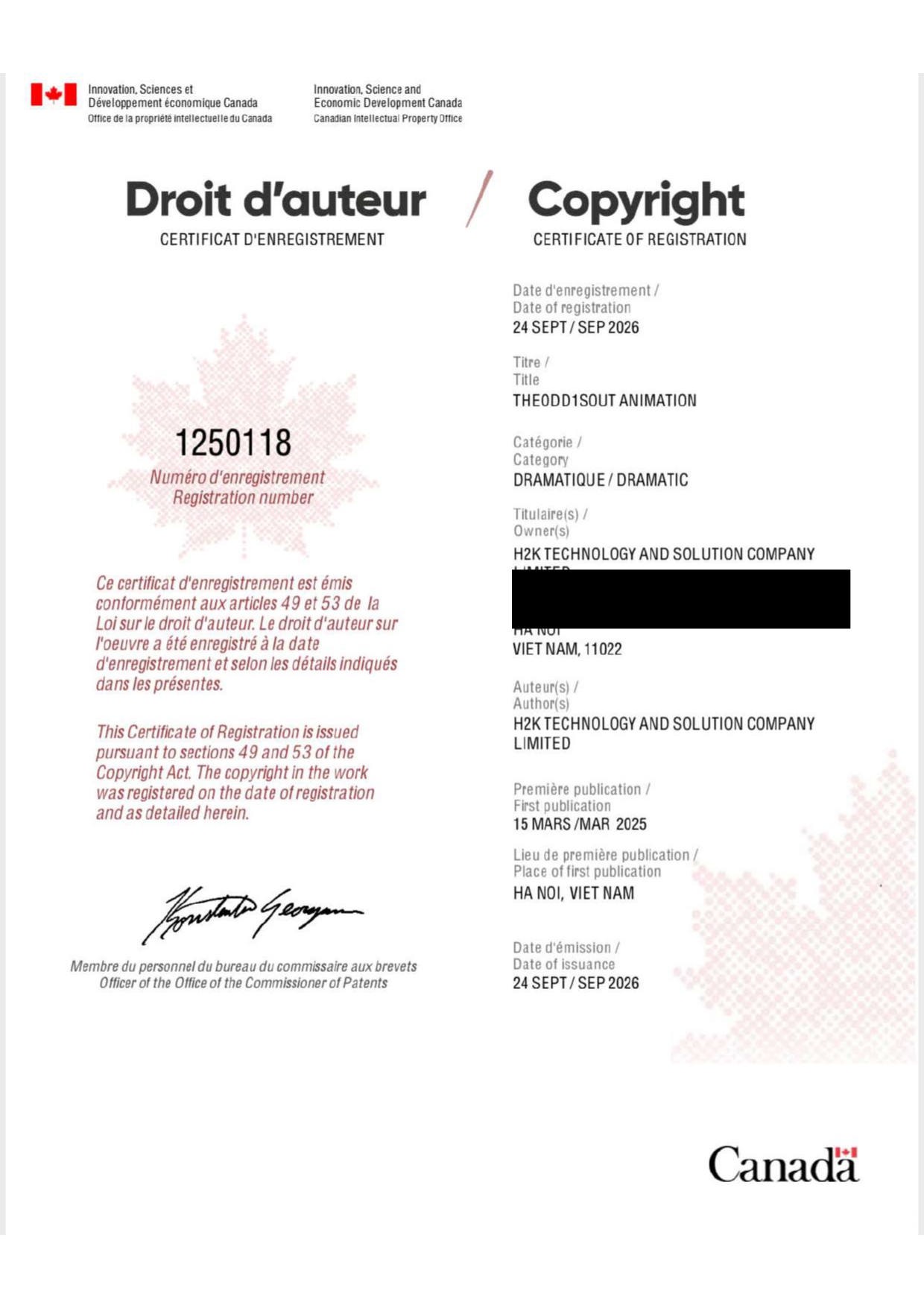
To illustrate how these registration benefits work in practice, consider the certificate pictured above, which we recently secured for our Vietnamese client, H2K Technology and Solution Company Limited. This official Certificate of Registration from the Canadian Intellectual Property Office (CIPO) provides formal, government-recognized evidence that copyright subsists in their original work, 'THEODD1SOUT ANIMATION,' and that H2K is the registered owner. While Canadian copyright protection arises automatically upon creation, this certificate is a powerful practical tool; as outlined in Section 4, it establishes a public record and provides crucial evidentiary support that the client can use to assert ownership, negotiate licensing deals, or challenge unauthorized use by platforms and infringers. By obtaining this registration, our client has significantly strengthened their legal standing and taken a proactive step to protect the commercial value of their creative asset in the Canadian market.
Why Registration Can Be Useful
Registration can help a business:
- Establish a public record associated with a work and its claimed owner.
- Support ownership claims when dealing with platforms, commercial partners, or alleged infringers.
- Provide useful evidence in copyright disputes.
- Organize and document important intellectual property assets.
- Support licensing, assignment, and other commercial transactions involving copyrighted material.
For businesses that depend heavily on original software, product photography, educational content, creative materials, or digital publications, registration may be worth considering for particularly valuable works.
When Should a Business Consider Registration?
Registration may be especially useful when a work has significant commercial value, is widely distributed online, or is likely to be licensed to third parties.
A company does not necessarily need to register every internal document or routine marketing asset. Instead, it should identify the works that are strategically important and assess whether formal registration would provide meaningful evidentiary or commercial benefits.
The most important point is that registration strengthens the available evidence; it does not replace clear ownership arrangements and reliable documentation.
5. Who Owns Copyright in Work Created for a Business?
Copyright ownership is one of the most important issues for businesses commissioning creative work.
Under section 13 of the Copyright Act, the author is generally the first owner of copyright. However, there is an important exception for works created by employees in the course of their employment.
Work Created by Employees
Where an employee creates a work in the course of employment, the employer is generally the first owner of copyright unless an agreement provides otherwise.
For example, if a company's marketing employee creates advertising graphics, website copy, or promotional videos as part of their employment duties, the company will generally own the copyright in those works, subject to the applicable employment agreement and circumstances.
Businesses should still maintain clear employment contracts and internal intellectual property policies to avoid uncertainty about ownership, permitted use, and the handling of creative assets.
Work Created by Freelancers and Independent Contractors
The situation is different when a business hires an independent contractor.
A freelancer does not automatically transfer copyright to the client simply because the client paid for the work. The freelancer is generally the first owner unless the copyright is assigned through an appropriate written agreement or another legal arrangement applies.
For example, a company may pay a designer to create a logo, website, or advertising campaign. Without a properly documented transfer of rights, the company may not own the copyright in the commissioned material.
This can create problems when the company later wants to modify the work, license it, transfer it, or take action against unauthorized use.
Why Written Agreements Matter
Section 13(4) of the Copyright Act provides that an assignment of copyright or a grant of an interest in copyright is not valid unless it is in writing and signed by the copyright owner or their duly authorized agent.
Businesses should therefore address intellectual property ownership in contracts with designers, developers, photographers, writers, marketing agencies, and other external service providers.
A well-drafted agreement should clarify:
- Who owns the copyright in the completed work.
- Whether the client receives an assignment or a licence.
- Whether the licence is exclusive or non-exclusive.
- Which territories, platforms, and uses are permitted.
- Whether the client can modify, reproduce, distribute, or sublicense the work.
- Whether third-party materials, stock assets, or licensed components are included.
- Whether the creator is required to waive moral rights where appropriate.
Businesses should also distinguish between copyright ownership and the right to use a work. A licence may provide extensive commercial rights without transferring ownership.
6. Understanding Moral Rights in Canada
Canadian copyright law protects creators through both economic rights and moral rights.
Economic rights concern the commercial exploitation of a work, including the ability to reproduce, publish, distribute, and authorize certain uses. Moral rights protect the personal connection between an author and their creation.
Moral rights belong to the author or creator, even when economic copyright has been transferred to another party.
- The Right of Attribution
The right of attribution, also known as the right of paternity, allows an author to claim authorship of a work or to remain anonymous or use a pseudonym.
This means that transferring copyright ownership does not automatically eliminate the creator's right to be identified as the author.
- The Right of Integrity
The right of integrity protects a work against distortion, mutilation, or modification that is prejudicial to the author's honour or reputation.
It can also be infringed where a work is used in association with a product, service, cause, or institution in circumstances that are prejudicial to the author's honour or reputation.
For example, a photographer may object to an alteration or association that damages their professional reputation, even if the business owns the economic copyright in the photograph.
- Can Moral Rights Be Transferred?
No. Moral rights cannot be assigned or transferred to another person. However, an author can waive them, either entirely or in part.
A waiver should be addressed expressly in the relevant agreement rather than assumed from a general copyright assignment or payment for services.
This distinction is particularly important for businesses that commission creative work and expect to edit, adapt, rebrand, or reuse it over time.
A copyright assignment and a moral rights waiver serve different legal purposes. Businesses should ensure that their contracts address both where appropriate.
7. What Is Fair Dealing and When Does It Apply?
Fair dealing is an important exception under Canadian copyright law. It allows certain uses of copyrighted material without the copyright owner's permission, provided the statutory requirements are satisfied.
However, fair dealing is not a general permission to copy material whenever the use appears reasonable or commercially convenient.
The Copyright Act identifies specific purposes for which fair dealing may apply:
- Research.
- Private study.
- Education.
- Parody.
- Satire.
- Criticism.
- Review.
- News reporting.
The analysis generally involves two stages: the use must be for an eligible purpose, and the dealing must be fair in the circumstances.
The Purpose of the Use
The first step is to determine whether the use falls within one of the purposes recognized by the Act.
For criticism, review, and news reporting, the Act also requires identification of the source and, where provided in the source, the name of the author or other relevant creator.
A business cannot simply label an ordinary commercial use as research, education, criticism, or review to avoid obtaining permission.
Whether the Dealing Is Fair
Even when a use falls within an eligible purpose, it must also be fair.
Canadian courts have considered several factors when assessing fairness, including:
Purpose of the dealing: Why was the material used, and was the use genuinely connected to an eligible purpose?
Character of the dealing: How was the material used, and was it distributed or reproduced repeatedly?
Amount of the dealing: How much of the original work was used in relation to the purpose?
Alternatives to the dealing: Were other ways of achieving the objective available without using the protected material?
Nature of the work: Was the original work published or unpublished, and what is its character?
Effect of the dealing on the work: Could the use compete with the original or negatively affect its market?
These factors are assessed contextually rather than as a mechanical checklist. No single factor automatically determines whether a use is fair.
Fair Dealing in Business Activities
Businesses should pay particular attention to fair dealing when using third-party content in marketing, research, training, commentary, publications, or educational materials.
For example, quoting a short passage from an article for genuine criticism or review may qualify, depending on the circumstances and attribution requirements. Reproducing an entire article on a company website simply because it is relevant to the business is a different matter and may require permission.
Similarly, the fact that a photograph is publicly accessible online does not mean that a business can freely download it and use it in advertising.
Fair Dealing Is Not the Same as Fair Use
Canadian fair dealing should not be confused with the broader fair use doctrine under United States copyright law.
Although both systems allow certain uses of copyrighted material without permission, they have different legal structures and requirements. Businesses operating in both countries should assess the applicable law rather than assuming that a use permitted in one jurisdiction will automatically be permitted in the other.
8. How Long Does Copyright Protection Last?
The general copyright term in Canada is the life of the author, the remainder of the calendar year in which the author dies, and an additional 70 years after the end of that calendar year.
This means that copyright generally expires at the end of the 70th calendar year following the author's death.
Canada extended the general term from life plus 50 years to life plus 70 years on December 30, 2022, as part of its implementation of commitments under the Canada-United States-Mexico Agreement (CUSMA).
The extension did not revive copyright in works for which protection had already expired before January 1, 2023.
Are There Exceptions?
Yes. The Copyright Act contains different rules for certain categories of works and circumstances, including:
- Works of joint authorship.
- Anonymous and pseudonymous works.
- Certain posthumous works.
- Crown copyright.
- Performers' performances and sound recordings.
- Communication signals.
For example, sound recordings and performers' performances have their own term rules, which differ from the general life-plus-70-year rule.
Businesses should therefore avoid assuming that every copyright-protected asset has the same expiration date.
What Happens When Copyright Expires?
When copyright protection expires, the work generally enters the public domain and can be used without permission under copyright law.
However, a new edition, adaptation, translation, recording, or other original contribution involving a public-domain work may contain separately protected material. Businesses should check the status of the specific version they intend to use rather than assuming that every related asset is free to reproduce.
9. How Does Copyright Work Across Canada and the United States?
Copyright protection is territorial, meaning that the applicable legal rules depend on the jurisdiction in which protection or enforcement is being considered.
However, international copyright agreements make it possible for works protected in one member country to receive protection in other participating countries without requiring a separate registration in every jurisdiction.
Canada and the United States are both members of the Berne Convention. As a result, qualifying Canadian works generally receive copyright protection in the United States, and qualifying U.S. works generally receive protection in Canada, subject to the applicable national laws.
Does Canadian Registration Automatically Register a Work in the United States?
No. Canadian copyright registration is not the same as registration with the United States Copyright Office.
A Canadian registration can provide useful evidence of ownership, but it does not replace any U.S. registration requirements that may apply to litigation involving a U.S. work.
The two countries also differ in certain aspects of copyright law, including exceptions, remedies, registration procedures, and statutory requirements.
Why This Matters for Canadian Businesses
Canadian businesses often publish content through international websites, social media platforms, online marketplaces, and hosting services located outside Canada.
If unauthorized copies appear on a U.S.-based platform, the business may need to consider the platform's reporting procedures and the legal framework applicable to the reported material.
For example, a DMCA notice may be an appropriate reporting mechanism for alleged copyright infringement on a U.S.-based service. However, the availability and legal effect of that process depend on the circumstances and the relevant provider.
Businesses should distinguish between the existence of copyright protection in another country and the specific procedures available for enforcing those rights there.
10. What Counts as Copyright Infringement?
Copyright infringement generally occurs when someone exercises an exclusive right of the copyright owner without authorization or a valid legal exception.
Under Canadian law, reproducing an entire protected work or a substantial part of it may constitute infringement.
The concept of a substantial part is not determined solely by the percentage of material copied. Canadian courts consider the qualitative importance of the material and the circumstances of the alleged copying.
Examples of potentially infringing conduct include:
- Reproducing photographs or illustrations without permission.
- Copying substantial portions of website content, articles, or reports.
- Uploading copyrighted videos or music without authorization.
- Distributing unauthorized copies of software or digital publications.
- Reusing marketing materials created by another business without a valid licence.
- Publishing substantial portions of protected educational or training materials without authorization.
Not every similarity between two works establishes infringement. A dispute may involve independently created material, unprotected ideas, factual information, authorized use, or an applicable exception.
A proper assessment should identify the original work, the material being used, the rights involved, and the legal basis for claiming that the use is unauthorized.
Online Infringement and Business Risk
Online infringement can be particularly difficult to manage because digital material can be copied and distributed quickly.
A photograph may be reused across multiple websites, a company's article may be republished without permission, or a video may be uploaded to several accounts and platforms.
The resulting harm may extend beyond lost licensing revenue. Unauthorized use can affect a company's reputation, mislead customers about the source of content, and reduce the commercial value of original creative assets.
11. How Can Canadian Businesses Enforce Their Copyright?
When a business discovers unauthorized use of its copyrighted material, it should first establish the ownership position and preserve evidence of the alleged infringement.
The appropriate enforcement method depends on the type of material, the identity of the alleged infringer, the location of the content, and the commercial impact.
Step 1: Confirm Ownership and Authorization
Before making a complaint, determine who owns the copyright and whether the reported use is covered by a licence, assignment, or other permission.
This is particularly important for commissioned work, collaborative projects, and content that includes third-party materials.
Step 2: Preserve Evidence
Businesses should record the location of the unauthorized material and preserve relevant information, such as:
- URLs and website addresses.
- Screenshots showing the reported content.
- Dates when the material was discovered.
- Copies of the original work.
- Available publication and ownership records.
- Relevant licence agreements or copyright assignments.
- Correspondence with the alleged infringer or platform.
Evidence should be preserved before the content is removed or modified wherever possible.
Step 3: Contact the Relevant Party or Platform
Depending on the circumstances, a business may send a cease-and-desist letter, contact the person responsible for the unauthorized use, or submit a copyright complaint through the relevant platform.
Where the material is hosted by a service provider, the business should follow the provider's reporting requirements. A notice should identify the protected work and the allegedly infringing material with sufficient detail to allow the provider to locate and assess the complaint.
For U.S.-based services, a DMCA notice may be relevant. For Canadian services, the Copyright Act includes a notice-and-notice regime under which qualifying notices are forwarded to subscribers, rather than operating as an automatic DMCA-style takedown process.
The distinction is important: a Canadian notice-and-notice notice does not itself require the service provider to remove the reported material.
Step 4: Consider Legal Remedies
If informal enforcement or platform reporting does not resolve the matter, the copyright owner may consider legal action.
Section 34 of the Copyright Act provides remedies for copyright infringement, including injunctions and damages. Depending on the circumstances, a copyright owner may also seek an accounting of profits or other available relief.
The Act also provides for statutory damages under section 38.1. In general, the statutory range is $500 to $20,000 for all infringements involved in the proceedings for each work or other subject matter where the infringements are for commercial purposes. For non-commercial infringements, the range is generally $100 to $5,000 for all works or other subject matter involved in the proceedings.
These are court-awarded remedies, not automatic payments triggered by discovering an unauthorized copy. The amount and availability of damages depend on the statutory requirements and the circumstances of the case.
Step 5: Monitor for Continued Infringement
Removing one unauthorized copy does not necessarily prevent the same work from appearing elsewhere.
Businesses should monitor relevant online channels, record repeated incidents, and follow up where new unauthorized uses are identified.
A consistent enforcement process helps businesses manage recurring infringement rather than responding to every incident as an isolated event.
12. Common Copyright Mistakes Businesses Should Avoid
Even businesses that understand the importance of intellectual property can make mistakes that weaken their ownership position or expose them to infringement claims.
Assuming Payment Means Copyright Ownership
Paying a freelancer, photographer, designer, or developer does not automatically transfer copyright. Businesses should use written agreements that clearly address ownership and licensing.
Believing Registration Creates Copyright Protection
Copyright generally exists automatically when an original work is created and fixed in a material form. Registration provides useful evidence, but it is not the source of the underlying protection.
Treating Online Content as Free to Use
Material being publicly accessible does not mean it is free for commercial reuse. Businesses should verify ownership and obtain permission or


