
10 Common DMCA Compliance Myths: What Creators & Platforms Get Wrong
The DMCA is one of the most frequently mentioned laws in online copyright enforcement. But it is also one of the most frequently misunderstood. A creator finds their content on another website and says, "I'll send a DMCA." A website owner receives a takedown notice and assumes they have automatically broken the law. A platform removes content after receiving a notice, and users assume the copyright dispute is permanently settled. None of these assumptions tells the whole story.
The Digital Millennium Copyright Act creates specific procedures and protections for online copyright disputes. For service providers, Section 512 establishes conditional safe harbors with particular requirements and obligations. For copyright owners, a takedown notice needs to contain specific information and representations.
Understanding the difference matters. A poorly prepared notice can be rejected. An inaccurate claim can create unnecessary legal risk. And failing to understand the process can make legitimate copyright enforcement much harder than it needs to be.
Here are 10 of the most common misconceptions about DMCA compliance, and why getting them right matters.
Table of Contents
- What Does DMCA Compliance Actually Mean?
- Myth #1: A DMCA Notice Automatically Removes Content
- Myth #2: Anyone Can File a DMCA Takedown
- Myth #3: You Don't Need to Own the Copyright
- Myth #4: Every Copy of Your Content Is Automatically Infringing
- Myth #5: You Can Send One Generic Notice for Everything
- Myth #6: DMCA Compliance Only Matters to Large Platforms
- Myth #7: A Takedown Notice Permanently Ends the Dispute
- Myth #8: Fair Use Doesn't Matter Once a Notice Is Filed
- Myth #9: Website Owners Can Ignore DMCA Notices
- Myth #10: More Takedown Notices Always Mean Better Protection
- Why DMCA Compliance Matters for Your Business
- How Pellonia Helps With Copyright Enforcement
- Frequently Asked Questions (FAQs)
- Final Thoughts
What Does DMCA Compliance Actually Mean?
Before addressing the myths, it helps to understand what the DMCA is actually doing.
Section 512 of the U.S. Copyright Act provides certain limitations on liability for qualifying online service providers when specified conditions are met. Those safe harbors apply to different categories of online activity and come with obligations that service providers must satisfy.
For example, a qualifying service provider seeking the hosting-related safe harbor under Section 512(c) must designate an agent to receive copyright infringement notifications and make the required agent information publicly available and registered with the Copyright Office.
For copyright owners, the DMCA also establishes a mechanism for notifying service providers about claimed infringement. In other words:
DMCA compliance is a process, not a magic button.
Myth #1: A DMCA Notice Automatically Removes Content
This is probably the most common misconception. Submitting a DMCA notice does not mean that the content is automatically removed.
A service provider may review the notification to determine whether it meets the applicable requirements and whether the material can be identified.
A compliant notice generally needs to provide information such as identification of the copyrighted work, identification or location of the allegedly infringing material, contact information, and required statements regarding the claimant's good-faith belief and the accuracy of the notification.
If the notice is incomplete or does not provide enough information, the service provider may not be able to act on it.
- Why This Matters
A vague statement such as:
"This website stole our content. Please take it down."
doesn't provide the same level of information as a properly documented notice identifying the copyrighted work and the specific infringing material. Specificity matters.
Myth #2: Anyone Can File a DMCA Takedown
Another common misconception is that anyone who discovers copied content can submit a copyright takedown.
That's not how copyright ownership works.
A DMCA notification is generally submitted by the copyright owner or someone authorized to act on the owner's behalf.
The notice also requires the complaining party to make representations concerning its good-faith belief that the disputed use is unauthorized and that the information in the notification is accurate, subject to the applicable legal requirements.
This is particularly important for agencies, employees, and enforcement companies. If you are acting for a client, your authority to do so should be clear.
- Why This Matters
Submitting a copyright complaint for material you don't own, or without appropriate authority, can undermine the complaint and potentially create additional legal issues.
Copyright enforcement should start with rights verification.
Myth #3: You Don't Need to Own the Copyright
Finding your company's logo, photograph, article, or video on another website doesn't automatically mean your company owns the copyright in that material.
Ownership can depend on how and by whom the work was created.
For example:
- An employee may have created the work.
- An independent contractor may have created it.
- A third party may have licensed it.
- Another company may own the underlying copyright.
- Multiple parties may have rights in different aspects of the work.
Before sending a DMCA notice, you should understand what rights you actually hold.
- Why This Matters
A legitimate infringement claim needs a legitimate rights basis.
The Copyright Office's requirements focus on the claimant's status as the legal or beneficial owner of rights in the relevant copyrighted work, or the appropriate authorization to act.
Don't confuse using content with owning copyright in it.
Myth #4: Every Copy of Your Content Is Automatically Infringing
Seeing your content somewhere else doesn't always mean the use is automatically unlawful.
Copyright law contains limitations and exceptions. One of the most important is fair use under U.S. law.
Depending on the circumstances, copyrighted material may be used for purposes such as criticism, commentary, news reporting, teaching, scholarship, or research.
The fact that someone has reproduced part of your work does not, by itself, answer the legal question of whether the use is infringing.
This is why copyright owners should consider applicable exceptions before submitting a takedown.
- Why This Matters
A strong enforcement program isn't about removing everything that looks similar. It's about identifying actual unauthorized uses.
Overreaching can turn a legitimate copyright protection program into a source of disputes.
Myth #5: You Can Send One Generic Notice for Everything
Copy-and-paste enforcement may look efficient. It can also create problems.
Different websites and platforms have different submission systems, evidence requirements, and processes. More importantly, every infringement should still be accurately identified.
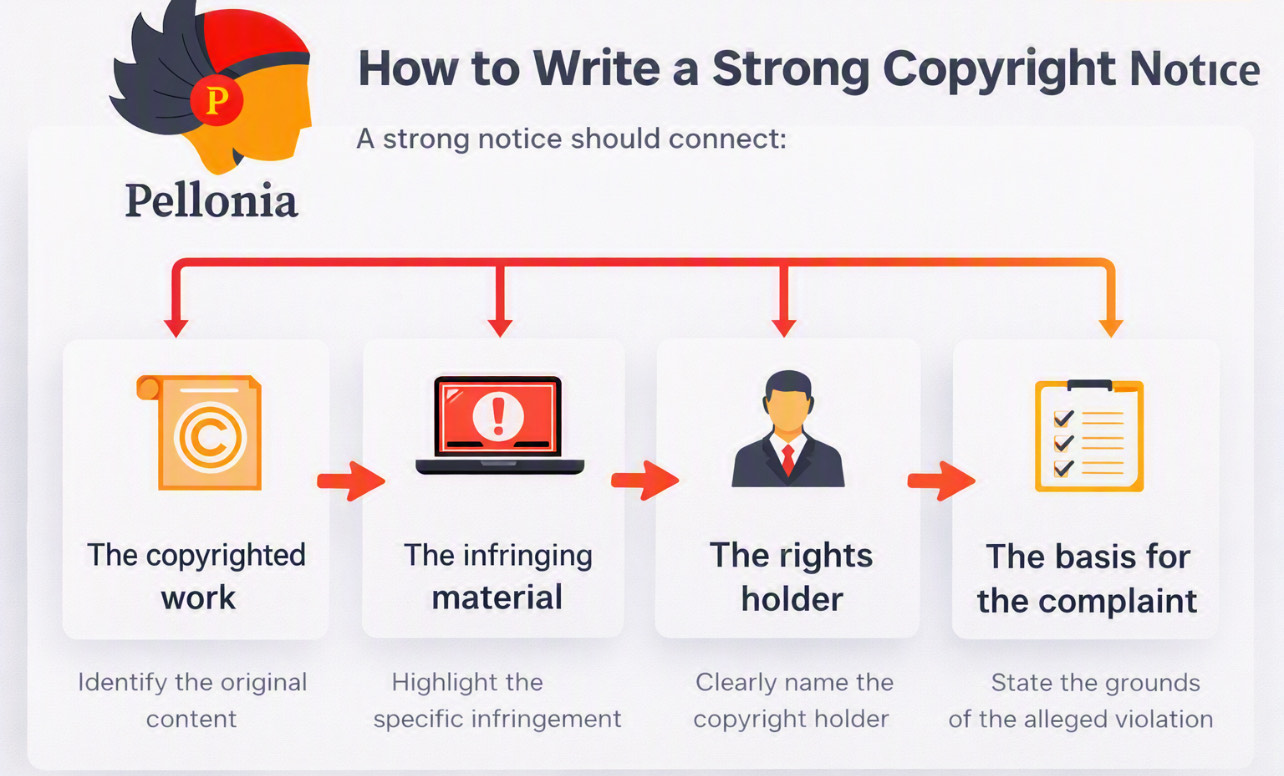
A strong notice should connect:
The copyrighted work → the infringing material → the rights holder → the basis for the complaint.
|
For example, a notice concerning ten different URLs should make it clear what copyrighted work is involved and where each allegedly infringing use appears.
- Why This Matters
The Copyright Office's framework requires enough information to identify both the copyrighted work and the allegedly infringing material.
A generic notice that forces the recipient to guess what is being challenged is much weaker than a precise, evidence-backed complaint.
Myth #6: DMCA Compliance Only Matters to Large Platforms
You don't need to operate a global social network to care about DMCA compliance.
Websites, hosting businesses, user-generated-content platforms, forums, marketplaces, and other online services may encounter copyright complaints.
For qualifying service providers seeking the applicable Section 512 safe harbors, specific obligations can apply.
For example, a service provider relying on the 512(c) safe harbor must designate and maintain information for an agent who receives copyright notifications.
The Copyright Office also explains that Section 512 contains multiple safe harbors covering different types of online activity, each with its own requirements.
- Why This Matters
Waiting until you receive your first copyright complaint to create an enforcement process is rarely a good strategy.
Businesses should know:
- Who receives copyright complaints.
- Where notices should be sent.
- How claims are reviewed.
- How evidence is preserved.
- How repeat infringers are handled.
- How counter-notifications are processed.
Compliance works best when it's a system, not an emergency response.
Myth #7: A Takedown Notice Permanently Ends the Dispute
A takedown isn't necessarily the end of the matter. Depending on the circumstances, the person whose material was removed may submit a counter-notification.
That means the rights holder may need to continue addressing the dispute after the original removal.
A counter-notification is a formal process, not simply an email saying:
"I disagree."
It has its own requirements and representations. The broader lesson is that copyright enforcement can involve multiple stages.
- Why This Matters
Businesses should preserve their evidence and correspondence.
Keep records of:
- The original work.
- Ownership documentation.
- Infringing URLs.
- Screenshots.
- Takedown notices.
- Platform responses.
- Counter-notifications.
- Relevant communications.
Good documentation becomes especially valuable when a simple takedown turns into a dispute.
Myth #8: Fair Use Doesn't Matter Once a Notice Is Filed
Submitting a DMCA notice doesn't erase the possibility of fair use.
In fact, the DMCA notice framework requires the complaining party to state that it has a good-faith belief that the disputed use is not authorized by the copyright owner, its agent, or the law.
That means the rights holder should consider whether an exception or other authorization may apply before filing. This doesn't mean every questionable use qualifies as fair use. It means that fair use is part of the analysis.
- Why This Matters
Consider a journalist who uses a short portion of a copyrighted video while reporting on the video itself.
That's very different from someone downloading the entire video and uploading it to another website as their own.
Context matters. Purpose matters. The amount used matters. And the legal analysis matters.
Myth #9: Website Owners Can Ignore DMCA Notices
The opposite side of the process has misconceptions too. Receiving a DMCA notice doesn't automatically mean the website owner is liable for infringement. But ignoring the notice can be a serious mistake.
For qualifying service providers seeking the applicable Section 512(c) safe harbor, the statute establishes procedures involving removal or disabling access to material upon receiving qualifying notifications, subject to the statute's requirements and conditions.
A responsible website operator should therefore have a process for:
- Receiving notices.
- Verifying that they relate to the site.
- Reviewing the information provided.
- Taking appropriate action.
- Communicating with the relevant parties.
- Handling counter-notifications where applicable.
- Keeping records.
- Why This Matters
Ignoring copyright complaints can create unnecessary risk and operational confusion.
A structured process allows legitimate claims to be addressed while giving the operator a framework for dealing with questionable or incomplete complaints.
Myth #10: More Takedown Notices Always Mean Better Protection
More is not necessarily better. A high-volume copyright enforcement program can be effective, but only if the underlying notices are accurate.
Sending large numbers of weak, duplicate, or unsupported complaints can create problems. It can waste resources. It can delay legitimate enforcement. And inaccurate representations can carry legal consequences.
The Copyright Office's framework recognizes claims involving alleged misrepresentations in copyright notifications or counter-notifications.
- Why This Matters
The objective shouldn't be:
"Send as many notices as possible."
It should be:
"Identify legitimate infringements and submit accurate, well-supported notices efficiently."
Quality is what makes enforcement scalable.
Why DMCA Compliance Matters for Your Business
For companies operating online, copyright issues can quickly become operational issues. A single unauthorized copy may not seem significant.
But multiply it by:
- Hundreds of websites.
- Thousands of URLs.
- Multiple social platforms.
- Video platforms.
- Marketplaces.
- File-sharing services.
Suddenly, manual enforcement becomes almost impossible. That's why businesses need a repeatable system.
A Strong DMCA Compliance Program Can Help You:
- Protect original content
Identify unauthorized use before it spreads. - Respond consistently
Use documented procedures instead of improvising every time. - Reduce unnecessary disputes
Make sure complaints are based on verified rights and evidence. - Maintain records
Keep ownership evidence, notices, responses, and enforcement outcomes organized. - Scale enforcement
Handle growing volumes without sacrificing accuracy.
How Pellonia Helps With Copyright Enforcement
For brands with significant digital content, copyright protection is an ongoing process.
Pellonia helps rights holders identify unauthorized use of their intellectual property across websites, social platforms, video platforms, messaging services, and other digital environments.
Our approach can include:
- Monitoring for unauthorized content.
- Identifying infringing URLs.
- Verifying copyright ownership and supporting evidence.
- Preparing accurate takedown requests.
- Submitting enforcement complaints through appropriate channels.
- Monitoring repeat infringements.
- Tracking enforcement outcomes.
- Escalating recurring or complex cases when appropriate.
The objective isn't simply to send more notices. It's to build a more accurate, organized, and effective enforcement process.
Frequently Asked Questions (FAQs)
Q: What is DMCA compliance?
A: DMCA compliance generally refers to following the applicable requirements and procedures established by the Digital Millennium Copyright Act. For online service providers, Section 512 provides certain safe harbors subject to specific conditions and obligations.
Q: Does a DMCA notice guarantee that content will be removed?
A: No. A notice must satisfy the applicable requirements and provide sufficient information to identify the copyrighted work and allegedly infringing material. A service provider may reject or decline to act on an inadequate notice.
Q: Can someone file a DMCA notice for content they don't own?
A: A copyright notification should be submitted by the copyright owner or an authorized representative. The notice includes representations concerning ownership or authorization and the complainant's good-faith belief.
Q: Is everything that copies my content automatically copyright infringement?
A: No. Copyright law includes exceptions and limitations, including fair use under U.S. law. Whether a particular use is infringing depends on the facts and applicable law.
Q: What information should a DMCA takedown notice contain?
A: A compliant notification generally needs to identify the copyrighted work, identify or provide information sufficient to locate the allegedly infringing material, provide contact information, include the required good-faith and accuracy statements, and contain an appropriate signature.
Q: What happens if someone submits a counter-notification?
A: A counter-notification can trigger the next stage of the DMCA process. The applicable procedure depends on the service provider and circumstances, and rights holders should preserve their evidence and respond appropriately rather than assuming the original takedown permanently resolves the matter.
Q: Do websites need a DMCA agent?
A: For a service provider seeking the Section 512(c) safe harbor, the statute requires designation of an agent to receive notifications and related information to be made publicly available and registered with the Copyright Office.
Q: Can inaccurate DMCA notices create legal problems?
A: Yes. Copyright law addresses misrepresentations in copyright notifications and counter-notifications, which is one reason rights holders should verify ownership, infringement, and the accuracy of their statements before filing.
Q: Is DMCA compliance only relevant in the United States?
A: The DMCA is U.S. law, but online copyright disputes frequently cross borders. A website, platform, rights holder, and alleged infringer can all be located in different countries. The appropriate enforcement strategy can therefore depend on the platform, jurisdiction, and applicable laws.
Q: How can Pellonia help with DMCA enforcement?
A: Pellonia helps rights holders identify unauthorized use of their content, collect supporting evidence, prepare accurate copyright complaints, manage recurring infringements, and coordinate digital enforcement across multiple platforms.
Final Thoughts
DMCA compliance is often reduced to one sentence:
"Someone copied my content, so I'll send a DMCA."
But effective copyright enforcement is more complicated than that.
You need to know who owns the work.
You need to identify the infringement.
You need to understand whether an exception may apply.
You need to submit the right information.
And you need to be prepared for what happens after the notice is sent.
For platforms and service providers, compliance is equally important. Section 512 safe harbors come with conditions, and maintaining a proper copyright-management process can be essential to operating responsibly within that framework.
The strongest copyright protection programs aren't built around sending the most notices.
They're built around accurate claims, reliable evidence, consistent processes, and continuous monitoring.
Your content is an asset. Treat its protection like one.
Pellonia helps brands protect their digital content through structured copyright monitoring, evidence-based takedowns, and ongoing IP enforcement. Contact us today!


