

App Store IP Takedown: How to Enforce Your Rights on Apple's App Store
Your brand name appears in an app. The app uses your logo. Its description looks suspiciously similar to your marketing copy.
Maybe it even offers a service that competes directly with yours, or creates the impression that your company is behind it. You want it removed from the App Store. But here's the part many businesses don't realize:
An App Store IP takedown is not simply a matter of reporting an app and waiting for Apple to delete it. Apple has specific processes for intellectual property disputes, and the appropriate route depends on what is actually being infringed. A trademark dispute is different from a copyright dispute. An app-name dispute is different from an App Store content dispute. And submitting the wrong type of complaint can make an otherwise legitimate case harder to resolve.
So, how does an IP takedown on the Apple App Store actually work? Let's break it down.
Table of Contents
- What Is an App Store IP Takedown?
- What Types of IP Infringement Can Affect an App?
- Trademark Infringement on the App Store
- Copyright Infringement on the App Store
- App Name Disputes: A Separate Process
- What Apple Asks for in an IP Complaint
- What Happens After You Submit a Complaint?
- Why Evidence Matters
- Common Mistakes in App Store Takedown Requests
- What If the Developer Disagrees?
- Why Monitoring Matters After a Takedown
- How Pellonia Helps With App Store IP Enforcement
- Frequently Asked Questions
- Final Thoughts
What Is an App Store IP Takedown?
An IP takedown is a request asking Apple to address content available through the App Store that allegedly infringes intellectual property rights.
Apple provides dedicated dispute forms for App Store content and app-name disputes. Its current process states that if you believe an app or Search Ad available through the App Store violates your intellectual property rights, you can submit a claim to Apple Legal.
But there's an important detail:
Apple does not treat every IP complaint the same way.
Depending on the issue, the appropriate complaint may involve:
- Trademark infringement
- Copyright infringement
- An app-name dispute
- Other intellectual property rights
Understanding which category applies is the first step.
What Types of IP Infringement Can Affect an App?
An app can potentially misuse intellectual property in several different ways.
For example, an application might:
Use a protected trademark in its name.
Copy a registered logo.
Reproduce copyrighted images.
Copy original written content.
Use copyrighted software or other protected material.
Create an overall presentation that falsely suggests brand affiliation.
Use a trademark in metadata or other App Store-facing materials.
The legal analysis depends on the specific facts. That's why a strong complaint doesn't simply say:
"This app is infringing my brand."
It explains what right is owned, what the app is doing, and why that use infringes the relevant right.
Trademark Infringement on the App Store
Trademark issues are particularly important because an app's name and presentation can become part of its identity.
Imagine a company owns the trademark BRANDX.
An unrelated developer launches an app called:
BRANDX Official
The app uses a similar logo and presents itself as an official service. The problem isn't necessarily that the developer copied a particular image. The bigger issue may be the unauthorized use of the trademark in a way that could cause users to believe the app is connected to the legitimate brand.
Apple has a dedicated process for reporting trademark infringement on the App Store. Apple also states that trademark infringement involving the App Store should be reported through its App Store trademark process.
What Makes an App Store Trademark Case Stronger?
Relevant evidence may include:
Trademark registration details.
The trademark owner's identity.
The app's name.
The app's developer information.
The app's icon.
Screenshots.
The app description.
Evidence of confusing similarity.
Evidence suggesting unauthorized affiliation or sponsorship.
The objective is to make the relationship between the registered right and the allegedly infringing use clear.
Copyright Infringement on the App Store
Copyright presents a different type of problem. An app may contain or distribute copyrighted material without authorization.
Examples can include:
Copyrighted images.
Videos.
Music.
Written content.
Original graphics.
Software code.
Other protected creative works.
Apple provides a separate infringement process for copyright claims. Apple states that a copyright notification should identify the copyrighted work, identify the allegedly infringing material, and provide enough information for Apple to locate it.
For a DMCA-based complaint, Apple also requires representations concerning ownership or authorization, good-faith belief, and the accuracy and completeness of the notification.
This is why simply saying "they copied my content" isn't enough. A proper complaint needs to identify what was copied and what rights you own in that material.
App Name Disputes: A Separate Process
This is one of the most important distinctions for brand owners. Suppose your company owns a trademark and wants to launch an app under that brand. You discover that another app is already using the name.
Apple provides a specific App Name Dispute process for this situation.
Apple explains that if an app is preventing you from using your trademark as an app name on the App Store, you can submit an app-name dispute. Apple will identify the app or apps blocking the desired name and, in most cases, contact the provider of the disputed app and ask them to work with you directly.
That is different from simply reporting an app for trademark infringement.
Why This Difference Matters
There are really two separate questions:
"Is this app infringing my trademark?"
and
"Is this app preventing me from using my trademark as my App Store name?"
The facts may overlap, but Apple's processes are not necessarily identical. Choosing the correct route can make the complaint much clearer.
What Apple Asks for in an IP Complaint
A strong IP complaint should be specific. Apple's dispute process states that claimants need to provide contact information, identify and describe the alleged infringement, and make the required representation that they own or are authorized to represent the relevant rights.
For copyright claims, Apple specifically asks for information such as:
Identification of the copyrighted work.
Identification of the allegedly infringing material.
Information sufficient to locate the material.
Contact information for the complaining party.
A good-faith statement.
Confirmation that the information is accurate and complete.
An appropriate signature.
For trademark or other IP complaints, the supporting evidence should similarly make the ownership and alleged misuse clear.
What Happens After You Submit a Complaint?
Submitting a complaint does not necessarily mean Apple will immediately remove the app.
Apple's current App Store dispute process says that, in most cases, content available through the App Store is provided by third-party developers. Upon receiving a submission, Apple may contact the provider of the disputed content regarding the claim and ask the parties to work directly toward resolving the issue.
Apple's general dispute-form guidance also states that it will generally respond by email with a reference number and that further communication regarding an existing matter should include that reference number.
This means the process can involve more than a simple:
Report → App disappears
Instead, it can involve:
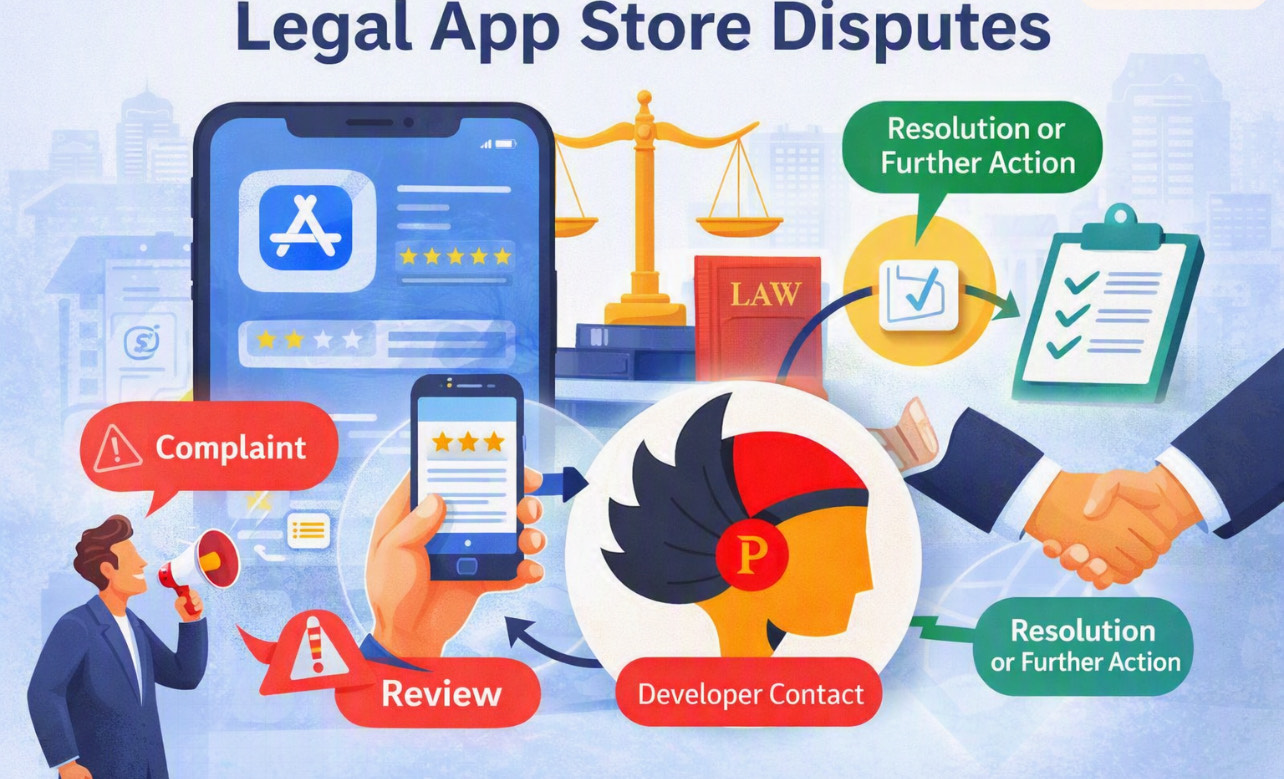
Complaint → Review → Developer contact → Resolution or further action
The exact outcome depends on the nature of the complaint and the evidence submitted.
Why Evidence Matters
An IP takedown request is only as strong as the evidence behind it.
Consider two complaints.
Complaint A
"This app is stealing our brand. Please remove it."
Complaint B
"Our company owns registered trademark X. The disputed application uses X in its app name and reproduces our logo without authorization. The app's presentation creates an apparent association with our company. Here is the registration information, the App Store URL, screenshots, and evidence of our official branding."
The second complaint gives Apple substantially more information to evaluate.
Build an Evidence Package
Depending on the case, preserve:
App Store URL.
App name.
Developer name.
App ID where available.
Screenshots.
App icon.
Description.
Trademark registration information.
Copyright ownership information.
Examples of copied material.
Evidence of unauthorized use.
Evidence of confusing affiliation.
If the app changes after your initial discovery, your earlier evidence can become particularly valuable.
Common Mistakes in App Store Takedown Requests
1. Using the Wrong IP Right
Not every brand problem is a copyright problem. If the issue centers on unauthorized use of a trademark, a trademark-focused complaint may be more appropriate.
2. Failing to Prove Ownership
A complaint should clearly establish who owns the relevant rights or who is authorized to act for the rights holder.
3. Providing a Generic Explanation
Apple needs to understand exactly what is being disputed. Specificity helps.
4. Ignoring the App Developer
The developer information can be important evidence and may help establish whether the app is actually affiliated with your company.
5. Treating the App Store Listing as the Only Problem
The app itself may contain additional infringing material that isn't immediately obvious from the listing.
A complete review can reveal a broader infringement.
6. Assuming One Takedown Solves Everything
An app may be removed while the same developer launches another application using a different name or slightly modified branding.
That is why ongoing monitoring matters.
What If the Developer Disagrees?
An IP complaint can become a dispute between the rights holder and the developer.
This is particularly important where the developer claims:
Authorization.
Licensing.
Independent ownership.
Fair use or another legal exception.
Lack of likelihood of confusion.
Lack of copyright infringement.
A legitimate reason for the disputed use.
A rights holder should therefore make sure its original complaint is accurate and properly supported.
Apple's copyright process specifically requires a good-faith belief that the challenged use is not authorized by the copyright owner, its agent, or the law. It also warns that knowing material misrepresentations of infringement can create liability under applicable law.
The goal should never be to remove legitimate competition simply because it is inconvenient. The goal is to enforce actual intellectual property rights.
Why Monitoring Matters After a Takedown
A successful removal isn't necessarily the end of the story. Bad actors can adapt.
They may:
Change the app name.
Replace the icon.
Modify the description.
Create another developer account.
Launch a new app.
Reuse the same copyrighted content.
Move the activity to another platform.
This is why modern IP enforcement increasingly involves both detection and enforcement.
Corsearch, for example, describes a broader brand-protection approach that combines monitoring, investigation, enforcement, and escalation rather than relying solely on isolated reactive takedowns.
For a valuable brand, the objective isn't just to remove today's infringement. It's to identify recurring patterns before they become tomorrow's problem.
How Pellonia Helps With App Store IP Enforcement
Apple's App Store is a critical distribution channel for businesses. That makes unauthorized use of your brand or copyrighted material there more than an isolated IP issue.
It can affect:
Brand reputation.
Customer trust.
App discovery.
Downloads.
Revenue.
User data.
Perceived brand legitimacy.
Pellonia helps rights holders identify and address unauthorized use of intellectual property across digital platforms, including app stores.
In a recent enforcement action, we submitted a DMCA takedown on behalf of a client against a popular application, providing evidence of our client's trademark rights. The developer refused to respond and left us ignored. We escalated to Apple under its App Store Content Dispute process, invoking App Review Guideline 4.1 and 5.2, which prohibit unauthorized use of another party's brand, icon, or product name without approval. Apple's rules require the developer to either resolve the matter directly with the rights holder or provide proof of authorization. When the developer failed to do either, Apple's own Developer Program License Agreement, which permits removal of apps when Apple reasonably believes third-party IP rights may be infringed, and more broadly "with or without cause", provided the basis for escalation. This is not an isolated IP issue; it is a direct threat to brand integrity on a critical distribution channel.
Our approach can include:
Monitoring App Store listings.
Identifying potential trademark infringement.
Identifying unauthorized copyrighted content.
Collecting evidence.
Reviewing developer and app information.
Preparing rights-based takedown requests.
Monitoring for repeat infringement.
Supporting broader digital brand protection strategies.
The objective is simple:
Protect the brand wherever customers encounter it.
Frequently Asked Questions (FAQs)
Q: Can I report an app on the Apple App Store for trademark infringement?
A: Yes. Apple provides an App Store dispute process for claims that an app or Search Ad violates your intellectual property rights, including trademark-related claims.
Q: Can I file a copyright takedown against an app?
A: Potentially, yes. Apple has a dedicated copyright infringement process for content available through its services, including the App Store. A copyright complaint needs to identify the protected work and the allegedly infringing material and satisfy Apple's applicable requirements.
Q: What if another app is using my trademark as its app name?
A: Apple has a dedicated App Name Dispute process for situations where an app is preventing you from using a trademark as an App Store app name.
Q: Will Apple automatically remove an infringing app after I submit a complaint?
A: Not necessarily. Apple reviews submitted claims and may contact the provider of the disputed content. The outcome depends on the nature of the claim, the evidence, and Apple's review.
Q: What evidence do I need for an App Store IP takedown?
A: Depending on the claim, useful evidence can include trademark registration details, copyright ownership information, the App Store URL, app screenshots, the app name, developer information, and examples showing the unauthorized use.
Q: Can I report an app using my trademark even if it doesn't copy my logo?
A: Potentially. Trademark infringement isn't limited to copying a logo. The analysis can also involve unauthorized use of a protected word mark or other trademark in a way that creates confusion or an improper association. The specific facts determine whether infringement exists.
Q: What happens after I submit an Apple IP complaint?
A: Apple generally acknowledges the complaint and may provide a reference number. For App Store disputes, Apple states that it will generally contact the provider of the disputed content and ask the parties to work directly toward resolving the issue.
Q: Can an app be infringing in multiple ways?
A: Yes. An app can potentially involve several IP issues at the same time—for example, trademark misuse in its name and unauthorized copying of copyrighted images or text inside the app.
Q: Why should I monitor the App Store after a takedown?
A: Because removing one app does not necessarily prevent another app from appearing later. Monitoring can help identify renamed, modified, or newly launched apps that continue the same infringement pattern.
Q: Can Pellonia help with Apple App Store takedowns?
A: Yes. Pellonia can help rights holders identify potentially infringing apps, organize supporting evidence, prepare rights-based enforcement requests, and monitor for recurring brand or content abuse.
Final Thoughts
An Apple App Store takedown isn't simply a button you press when you see an app you don't like. It's an IP enforcement process. The first question is always:
What right is actually being violated?
Is it your trademark? Your copyright? Your app name? Or something else?
Once you identify the right, the next step is to build the evidence around it.
Identify the app. Document the infringement. Establish ownership. Choose the appropriate Apple process. Submit a clear and accurate complaint. And keep monitoring after the matter is resolved.
Because protecting your intellectual property isn't only about removing one infringing app.
It's about protecting the brand, content, and reputation that your business has spent years building.
Pellonia helps brands turn individual App Store infringements into a structured, evidence-based IP enforcement strategy.
Contact us now.


