
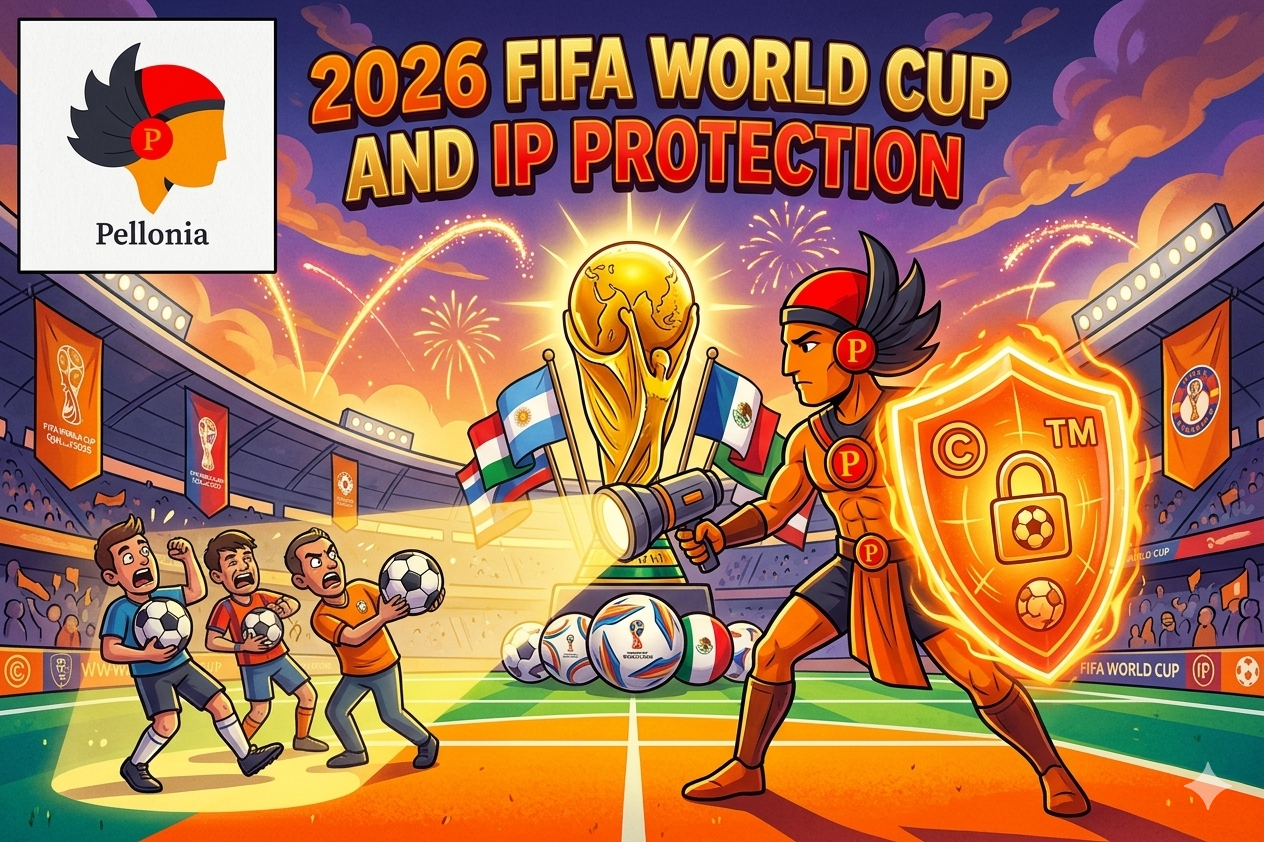
The whistle is about to blow on the biggest tournaments in soccer history. With the FIFA World Cup 2026™ spanning three countries and the FIFA Club World Cup 2025™ debuting in the U.S., the commercial buzz is deafening. But here is the reality check: If you are a brand, trademark owner, or agency looking to "celebrate" the games without a license, FIFA's legal team is playing harder defense than ever.
At Pellonia, we specialize in keeping you on the right side of the touchline, helping you secure your IP rights or navigate marketing without getting a cease-and-desist.
Table of Contents
- The Two Giants Coming to North America
- Why FIFA Plays Hardball with Its Brand
- Analyzing FIFA's Rulebook: What Actually Matters
- The "Clean Zone" Trap: What Businesses Don't See Coming
- The Legal Triple Threat: Players, Trademarks, & Ambush Marketing
- How Pellonia Helps You Secure Your IP Rights
- Frequently Asked Questions (FAQ)
The Two Giants Coming to North America
Let's look at what is actually happening in 2026 FIFA World Cup. According to FIFA's internal guidelines, it will be hosting 48 teams across Canada, Mexico, and the US.
Here is the kicker: FIFA admits they cannot afford to run these tournaments without their sponsors (think Adidas, Coca-Cola, Home Depot). Because those sponsors pay billions, FIFA sells them exclusivity. That means if you aren't a rights holder, FIFA views any commercial association as theft of their funding stream.
Why FIFA Plays Hardball with Their Brand
You might think, "I'm just a local pub running a special." But FIFA's guidelines are ruthless. They protect everything: the "Official Emblem," the "Worldmark," the specific typeface ("FWC 26"), the slogan "WE ARE 26," and even the silhouette of the trophy.
The documents are very clear: Only "FIFA Rights Holders" (sponsors, licensees, DAZN for media) can use these for money. If you aren't one, you cannot use the words "FIFA," "World Cup," or "Club World Cup" in your ads. Why? Because if everyone did it for free, the sponsors would walk away, and the tournament would collapse.
Love it or hate it, that is their legal argument.
Analyzing FIFA's Rulebook: What Actually Matters
Let's put aside the fluff and look at the actual clauses from the FIFA World Cup 26™ IP Guidelines. They aren't suggestions, they are a legal roadmap for litigation.
Here is what the fine print really says.
1. The "Totality" Clause
FIFA World Cup 26™ IP Guidelines contain a disclaimer saying the examples are "non-exhaustive." That is lawyer-speak for "Just because we didn't list it doesn't mean it's legal."
FIFA reserves the right to decide what counts as an infringement on the fly. This creates massive uncertainty for brands.
You cannot rely on a checklist; you need a legal strategy.
2. The Proximity Rule
The guidelines explicitly ban using Official IP "together with, or in proximity to, a company logo." This is brutal for co-branding.
If you run a news article about the tournament but slap your "Brought to you by..." banner next to the official emblem, you have crossed the line.
3. The Static Use Ban
You cannot use the Official Emblem as a "static" element on your website, like a background wallpaper or a corner logo on every page of a special section.
Why? Because FIFA argues that repeated, static placement suggests official endorsement. Even media outlets have to rotate or limit their use of the marks to stay editorial rather than commercial.
4. The Countdown Clock Trap
Here is a hidden gem: "Any commercially branded tool created to count down to the Tournament creates an unauthorised association."
If your brand puts a "47 days until kickoff" widget on your homepage with your logo attached, you are ambushing. Even without a single trademarked word, the function of counting down to a FIFA event creates a commercial link in FIFA's eyes.
5. Merchandise & "Generic Terms"
FIFA explicitly says items with "generic football terms" or "country names" are fine. But here is the trap: You cannot make a shirt that says "USA 26" in a font that vaguely looks like the official "FWC 26" typeface. The guidelines protect the specific typeface via design registration.
So "generic" means truly generic, think Arial font, no trophy shapes, no specific color gradients from the host city posters.
6. Hospitality Guest Branding
If you bring a corporate group to a match, your guests cannot wear matching branded shirts or carry signs with your company logo. FIFA views this as "unauthorised association" inside the stadium.
So that corporate outing where everyone wears the same Nike polo? Denied at the gate if the security team flags it as non-FIFA branding.
What this analysis tells us:
FIFA's rules are designed to be over-inclusive. They want to scare off
any brand that isn't paying. The burden is on you to prove your use is
not an infringement, not on FIFA to prove it is.
That is why you need Pellonia to draw the line for you.
The "Clean Zone" Trap: What Businesses Don't See Coming
This is where most people get blindsided. It isn't just about your Instagram ad.
For the 2026 World Cup, host cities (like Toronto, Vancouver, and the US venues) are legally required to set up "Clean Zones." In Toronto, for example, there will be a 2-kilometer radius around the stadium where unauthorized commercial activity is banned.
What does that mean practically?
- Restaurants/Bars: You can show the game (with a commercial subscription), but you cannot put a "World Cup Burger" on your sign if the sign implies sponsorship.
- Retailers: No selling unofficial jerseys or knock-off scarves within that zone.
The "Bavaria" Lesson: As noted in the legal analysis, FIFA once sued people wearing specific orange dresses because they promoted a beer that wasn't Budweiser. If your staff wears matching a specific trademark shirts you might get ejected.
The Legal Triple Threat: Players, Trademarks, & Ambush Marketing
Most business owners think trademark law is the only danger. Wrong. As the Sports Law Playbook points out, a single bad ad can hit you with three lawsuits at once:
- FIFA's Trademark Claim: You used a logo or a hashtag like #TakeItToTheWorld. (Yes, that slogan is trademarked).
- The Player's Right of Publicity: You used a photo of Christian Pulisic or Kylian Mbappé watching a game. In the US, states like California and New York have strong "Right of Publicity" laws. A player can sue you for implying they endorse your taco special.
- False Endorsement (Lanham Act): Even if you don't use a logo, if your ad confuses people into thinking you are an "Official Sponsor," you violate federal law.
If you are streaming the game in your bar, remember: Using a residential subscription (your home login) to broadcast in a commercial space is copyright infringement.
You need a commercial license from Bell Media (TSN/RDS) or the local rights holder.
How Pellonia Helps You Secure Your IP Rights
Navigating this maze is impossible with a simple Google search. The rules change based on the city, the venue, and the date (rules tighten on match days). You don't need a referee; you need a guide.
At Pellonia, we don't just tell you to "stop." We build a strategy to secure your rights.
Frequently Asked Questions (FAQ)
Q: Can I say "World Cup" on a sign in my bar window?
Probably not. FIFA claims exclusive rights to "World Cup" when used commercially to sell products. You can say "Watch all 104 matches here" or use generic terms like "football festival." Avoid "FIFA," "World Cup 26," and the trophy logo.
Q: I bought tickets. Can I raffle them off on my Instagram to promote my business?
Absolutely not. The guidelines states tickets cannot be used for "prize draws, incentives, or online auctions." If FIFA finds out, they will cancel those tickets, and the winner will be denied entry at the gate.
Q: What if I just use a generic soccer ball and the colors red and white?
That is safer. FIFA explicitly says "generic football or country-related images" are fine. Just don't copy the specific "look and feel" of the official posters (e.g., the specific 2026 typeface or gradient).
Q: I am an influencer. Can I use a FIFA hashtag like #FIFAWorldCup?
Only if you have no commercial benefit (i.e., you are a fan posting to your friends). If you are a "profile with commercial benefits" trying to attract attention to your brand, using the official hashtags creates an "unauthorised association" and violates the rules.
Q: Is public viewing illegal?
No, but it requires a license. You cannot just set up a projector in a parking lot. You need to apply for a "Public Viewing Event Licence" via FIFA's portal. Unlicensed public viewings with sponsor banners will be shut down.
Don't wait until the June 2026 kickoff to find out your marketing campaign is illegal. Whether you want to become a licensee, stop competitors from ambushing your sponsorship, or simply run a legal promotion for the 2026 Club World Cup, Pellonia is your legal backline.
Stop guessing. Start protecting.
Contact us today to schedule your IP compliance audit. Let's make sure your brand celebrates a victory, not a legal loss.
© Pellonia — Intellectual property enforcement & brand protection. This content is for informational purposes and does not constitute legal advice.