
In the vast ecosystem of user-generated content platforms, few regions present as much opportunity, and as much risk, as the markets of Eastern Europe. At the heart of this digital landscape lies a giant that many in the West have barely heard of: Odnoklassniki, commonly known as OK.ru or simply OK. With nearly half a billion monthly visits, it is a cornerstone of social interaction for millions. But for copyright holders, this massive popularity comes with a significant downside.
As a platform built on user-generated content, OK.ru is frequently flooded with illegal copies of blockbusters, music videos, and educational materials. At Pellonia, we specialize in navigating these complex digital terrains. We don't just monitor for piracy; we enforce your rights, submitting DMCA notices and ensuring your content is protected. In this post, we'll explore the history of this social media behemoth, break down its copyright policies, and show you, with a real-world example, how we help clients like Kenhub reclaim their content from pirates.
Table of Contents
- What is OK.ru? A Giant in the East
- The Scale of the Platform (And the Problem)
- A Brief History: From Hobby to Holding
- The Copyright Dilemma on UGC Platforms
- Case Study: How Pellonia Protected Kenhub on OK.ru
- Understanding OK.ru's DMCA Policy
- Why Manual Detection Fails and Technology Prevails
- Frequently Asked Questions (FAQ)
What is OK.ru? A Giant in the East
Launched on March 4, 2006, by Albert Popkov, Odnoklassniki (which translates to "Classmates") was designed to reconnect former school friends, similar to Classmates.com in the US. However, it rapidly evolved into a full-fledged social networking and video sharing empire. Now owned by VK (formerly Mail.ru Group), OK.ru supports 13 languages, including Russian, Ukrainian, Uzbek, Turkish, and even English, reflecting its broad reach across the CIS, MENA, and Eastern European regions.
While it may rank 49th in global web traffic, its dominance in specific markets is absolute. For brands and creators looking to expand eastward, visibility on OK.ru is non-negotiable. However, that visibility is a double-edged sword.
The Scale of the Platform (And the Problem)
To understand the piracy challenge, you must first understand the scale:
Monthly Visits: 542 million.
Daily Video Views: In 2022, the platform generated an average of 700 million daily video views, with 76% coming from mobile devices.
Revenue: The social media unit of VK Holding, which includes OK, generated $800 million in 2022.
These numbers represent a massive audience, but for rightsholders, they also represent a massive distribution network for stolen content. UGC platforms rely on user uploads, and unfortunately, those uploads often include copyrighted blockbusters, sports broadcasts, and educational series posted without permission.
A Brief History: From Hobby to Holding
The journey of OK.ru is a fascinating tale of internet history. Popkov, a telecommunications professional living in London, initially built the site as a hobby project between March and November 2006. As user numbers skyrocketed, what began as a pastime quickly became a business.
By July 2007, the platform had 3 million users. However, success brought legal battles. In 2008, British company I-CD accused Popkov of using proprietary information from his previous employment to build the site. The lawsuit was eventually settled, but it led to Popkov selling a controlling interest to Digital Sky Technologies (DST) in 2008.
Over the years, OK.ru weathered many storms. It briefly introduced paid registration in 2008, a move that backfired as users fled to competitor VKontakte, before reverting to a free model in 2010. It survived government blocks in Ukraine following the 2017 sanctions and continues to thrive, constantly adding features like video chat, music sections, and live broadcasts.
Despite its tumultuous history, one thing has remained constant: the platform's struggle with unauthorized content.
The Copyright Dilemma on UGC Platforms
For platforms like OK.ru, the volume of uploads makes pre-screening impossible. OK.ru does not employ pre-filtering systems to block copyright-infringing uploads before they go live. This means the burden of detection falls entirely on the copyright holder.
While OK.ru is compliant with the Digital Millennium Copyright Act (DMCA), the "notice and takedown" process is reactive, not proactive. By the time you find the infringement, your content may have already garnered thousands, or millions, of views, diluting its value.
This is where Pellonia bridges the gap. We don't just wait for you to stumble upon pirated content. We actively scan, identify, and act.
Case Study: How Pellonia Protected Kenhub on OK.ru
Theory is important, but results matter most. Recently, we had the privilege of IP protection for Kenhub, a leading provider of high-quality educational materials for learning human anatomy.
Kenhub invests immense resources into creating accurate, detailed anatomical videos and texts. Unfortunately, their success makes them a prime target for pirates looking to attract traffic by offering premium content for free.
The Discovery
During a routine sweep using our advanced scanning tools, our team at Pellonia identified several user profiles on OK.ru that had uploaded Kenhub's proprietary educational videos. These were not just short clips; they were full-length lessons, rebranded and embedded with third-party ads, effectively stealing Kenhub's revenue stream.
The Action
Speed is critical in content protection. Once the infringing material was located, we immediately:
- Documented the Infringement: We captured evidence of the stolen material, including URLs, uploader profiles, and view counts.
- Verified Rights: As Kenhub's authorized agent, we ensured all legal documentation was in order to prove ownership.
- Submitted the DMCA Notice: We filled out OK.ru's official copyright complaint form, providing all mandatory fields and guarantees of authenticity required by the platform.
The Result
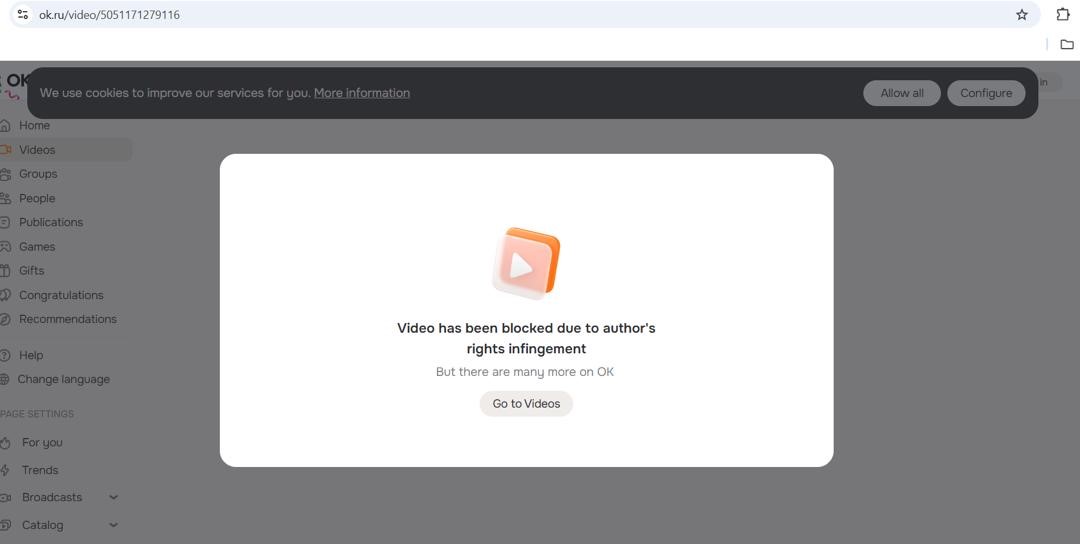
Based on industry experience, the average response time for content removal on OK.ru is about one hour. In Kenhub's case, we saw a similarly swift resolution.
"The post containing our stolen educational material was blocked and removed from OK.ru. The infringement was stopped before it could cause further damage to our brand and revenue."
Understanding OK.ru's DMCA Policy
OK.ru's legal framework is designed to protect rightsholders, but only if you follow their specific protocols. According to the platform's Help Center, copyright holders (or their agents) must fill out a specific form to initiate a takedown.
Key Requirements for a Successful Takedown:
- Complete Information: All mandatory fields on the form must be filled out accurately.
- Veracity: You must guarantee that the information provided is true and that you have the authority to act on behalf of the copyright owner.
- Proof of Ownership: You must confirm that the intellectual property in question was uploaded to OK.ru without permission.
The requests are processed in the order they are received. This is why accuracy matters, a single mistake in the form can delay the process, pushing your request to the back of the line while your content continues to circulate.
By partnering with Pellonia, you ensure that every notice is crafted perfectly the first time, minimizing delays and maximizing removal speed.
Why Manual Detection Fails and Technology Prevails
Some vendors claim to cover OK.ru, but they often rely on manual identification. Given the platform's massive size, manual detection is like finding a needle in a haystack while blindfolded. It requires immense resources and often misses renamed or distorted copies.
Pellonia utilizes advanced video fingerprinting technology. Unlike basic hashing (which only finds exact copies) or audio fingerprinting (which fails with altered sound), our technology detects copies regardless of:
- Metadata changes (renamed files)
- Video distortions (cropping, logos, color modifications)
- Audio alterations (unofficial dubbing, speed changes)
We scan in one click and provide you with instant matching results, including clickable links, view counts, and upload dates.
Frequently Asked Questions (FAQ)
Q: What is OK.ru?
A: OK.ru, or Odnoklassniki, is a major social media platform based in Russia, popular across Eastern Europe and the former Soviet Republics. It has over 200 million registered users and is known for its video-sharing capabilities.
Q: Is OK.ru compliant with copyright laws?
A: Yes, OK.ru is compliant with the Digital Millennium Copyright Act (DMCA). They provide a mechanism for copyright holders to request the removal of infringing content, but they do not proactively filter uploads.
Q: How long does it take to remove infringing content from OK.ru?
A: Based on our experience at Pellonia, once a valid DMCA notice is submitted, it takes approximately one hour on average for OK.ru to remove the infringing material.
Q: Can I just submit the DMCA notice myself?
A: Yes, you can. However, the process requires filling out all mandatory fields accurately and providing guarantees of authenticity. Any mistakes can delay the process. Pellonia acts as your authorized agent, ensuring the process is handled quickly and correctly, as we did for Kenhub.
Q: What types of content are most at risk on OK.ru?
A: Given the platform's high volume of daily video views (700 million), video content is the most targeted, including movies, TV shows, music videos, and educational series.
Don't let your content become someone else's profit. Contact Pellonia today to schedule a scan of OK.ru for your titles and see how quickly we can secure your digital assets.


